

Petrus Wandrey
As the pioneer of Digitalism in art, Petrus Wandrey (1939–2012) forged a visionary world uniting technology, science, and imagination, establishing himself as one of Germany’s most original postwar artists.
Wandrey himself appointed us to manage his estate, the majority of his Oeuvre.
Decades before digital technologies became part of everyday life, Petrus Wandrey was already asking what they would mean for human identity. Born in Dresden in 1939 and based in Hamburg for most of his career, he occupies a singular position within postwar German art as the artist who gave the emerging digital age its first distinct visual form.
Wandrey trained at the Hochschule für bildende Künste in Hamburg and began his career as a graphic designer. He produced record covers and visual concepts for major labels such as Polydor, Philips, Capitol, Atlantic, and WEA, among them designs for artists like The Who. These early works already show a distinctive sense of fragmentation and bold image construction. The American art critic David Galloway later examined this formative phase in detail.


In the early 1970s, Wandrey turned increasingly toward independent artistic production, initially within a surrealist context. A decisive moment occurred when he presented his sculpture Venus’ Wind to Salvador Dalí, who installed the work in the Mae West Room of the Teatro-Museo Dalí in Figueres. Dalí recognized the originality of Wandrey’s approach, yet urged him to move beyond Surrealism and develop his own visual language. This encounter marked a fundamental shift, redirecting Wandrey away from quotation toward invention and establishing the conceptual basis for his later work.

THE NEW ART TIMES, 2007
Petrus Wandrey and his assistant in the CASA DIGITALIS Atelier in Hamburg.


CHIPMEMBER, 1988
That new language took shape by the late 1970s, following Wandrey's move to New York and his contact with the intellectual and technological environment around Fordham University.
In Science and Beyond (1978), one of his earliest works to integrate electronic components into pictorial structures, the human figure dissolves into modular forms while technology becomes subject and material at once. Wandrey did not depict the digital world.
He constructed it within the artwork itself, using circuit boards and electronic components to build a visual order of reduction and precision. He called this language Digitalism.
Wandrey developed a consistent and highly controlled aesthetic system that spans painting, relief, sculpture, and object art.
At its center stands the transformation of the human image.
In his dancer figures and mask works, the body appears as a coded structure oscillating between figuration and abstraction.
His portraits often follow the same logic, using circuit boards, microchips, cables, and masks, combined with printed pixels.
Even cultural icons such as the Mona Lisa were translated into this pixel language, anticipating the image culture of our present.

PIXELMOUSE, 2009

COOL-COOL, 1997

CULTWARE RED & BLUE, 1991

The connection between Wandrey and the Sabatier family reaches back to the late 1990s, when Eduard Sabatier acquired one of the artist's works and became an early supporter. Over the years, a close personal friendship developed between Petrus Wandrey and Torsten Sabatier, who actively advanced the artist's practice.
In 2000, Torsten and Frank Sabatier opened a further chapter in Wandrey's work. Drawing on their long-standing partnership with the Meissen porcelain manufactory, they initiated a collaboration that allowed the artist to translate Digitalism into an entirely new material. Wandrey brought the pixel into porcelain. He even showed the manufactory new ways of working with its own medium: to achieve sharp pixel edges, he introduced waterjet cutting technology, and his vases combine porcelain with metal elements,
a departure from centuries of Meissen tradition.
Torsten Sabatier also initiated major commissions, including "Rat Pack" (2006) for Eventim and "Nano-Tec-Med" (2006) for Johnson & Johnson Germany, and organized exhibitions. In the final year of his life, Wandrey personally asked him to carry his work into the future. Following the artist's death in 2012, the Sabatier family assumed stewardship of his estate from his widow, Ute Janssen, with whom they remain in close contact to this day, as they do with many companions of Wandrey's artistic journey.
FAUSTUS, 1992

Petrus Wandrey and Torsten Sabatier, 2002




DANCER 2, 2001
AMPHORA, 2001
DIGIT 16, 2001
DANCER 4, 2001
DRAGON VASE, 2001
KRATER VASE, 2001
DIGIT 4, 2001

BANKHOUSE, 1997
For Wandrey, technology and human imagination were inseparably linked. His works reveal that behind the apparent coldness of technical systems lies human meaning, and that even a circuit board can carry a face and a story.
Today, his work offers an early artistic reflection on questions that define the twenty-first century, from artificial intelligence to the relationship between humans and machines, capitalism and pop culture, technology and war.


MONA-MONEY, 1998 & CIRCUIT DANCER 4, 1986
More from the Estate
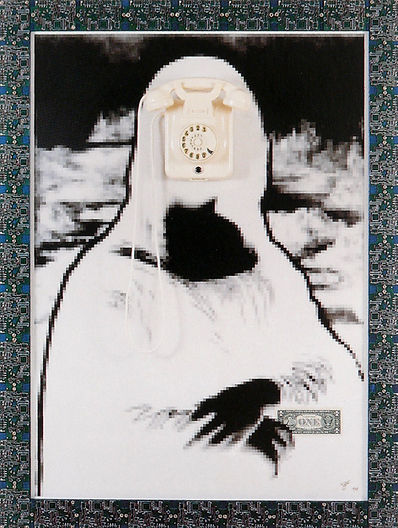
CALL-BOY
1998
Telephone on acrylic glass, clear varnish on dollar bill, on plotter print, on plastic sheet.
Framing: Circuit boards on varnished wood.
122,1 x 92,2 cm
Unique

CALL-MADAME
1996
Acrylic glass, clear varnish on dollar bill and plot print, on KS board.
Framing: Circuit boards on varnished wood.
122,1 x 92,2 cm
Unqiue

CALL-GIRL
1998
Telephone on acrylic glass, clear varnish on dollar bill, on plotter print, on plastic sheet.
Framing: Circuit boards on varnished wood.
122,1 x 92,2 cm
Unique

LOVE EVOLUTION
1996
Chips, circuit boards, acrylic, 1914 calendar on wood, glass, aluminum frame.
37 x 47 cm
Series of 6


VIRTUAL CONTACT
1994
Paint, ink, electronic components on handmade paper and acrylic glass, screwed onto a plastic sheet.
163 x 112,5 cm
Series of 20 unique editions

ASCENSION
1989
Acrylic skeleton model, electroplated gold, painted aircraft model, circuit boards on painted wooden construction, glazing
94 x 88 x 19,5 cm
Unique
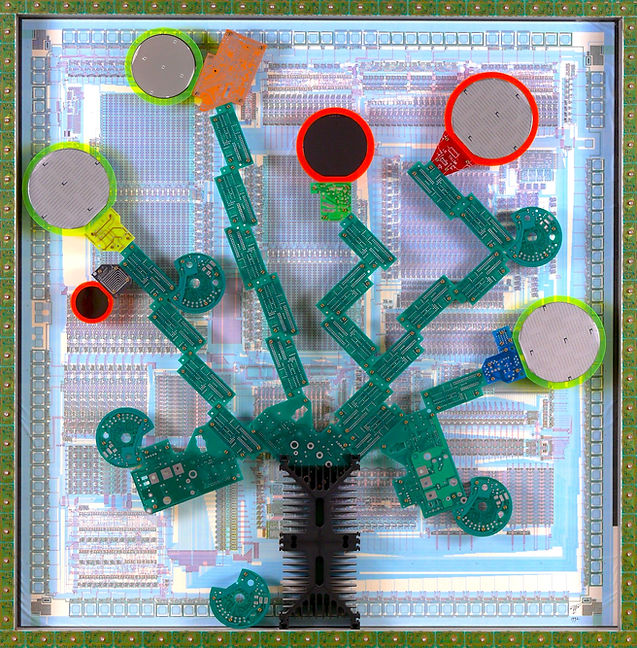
OVERGROWTH
1992
Circuit boards and heat sinks on plot.
101,5 x 99,5 x 7 cm
Unique

King Cool & Queen Cool
2007–2008
Gilded circuit boards, anodized heat sinks on a 2 mm cut-out stainless steel.
45.5 × 24.4 × 14.4 cm,
44.2 × 18 × 14.4 cm
Edition of 12 + EA
Collectors' Circle
The Petrus Wandrey Collectors' Circle offers a curated gateway into the artist's estate. Limited to 1,000 members worldwide, it grants defined acquisition rights to original works, from graphic editions to unique paintings and sculptures. Members receive priority information on newly available works, invitations to private previews, and direct dialogue with the estate.